Showing posts with label Macbook Pro. Show all posts

Monday, 1 January 2018

What to Expect From Apple in 2018: Three New iPhones and iPad Pro With Face ID, HomePod, Refreshed Macs, and More

Like 2017, 2018 promises to be a major year for Apple, with many new products on the horizon. We"ll get Apple"s first smart speaker -- the HomePod -- this year, along with a second-generation version of the iPhone X accompanied by a larger-screened version for those who want to go even bigger.

A new iPad Pro with Face ID is said to be in the works, and this is also the year when Apple"s AirPower wireless charging mat will debut. Beyond that, we can expect Mac refreshes, new software, a new Apple Watch, and maybe that new modular Mac Pro.


Below, we"ve rounded up all of the products we"re expecting to see from Apple in 2018 based on both current rumors that we"ve heard so far and past release information.

HomePod - Early 2018


HomePod is Apple"s first Wi-Fi connected smart speaker, designed to compete with existing smart speakers like the Amazon Echo and the Google Home. It was originally meant to debut in December, but Apple delayed its launch to an unspecified date in "early 2018."

With HomePod, Apple focused on sound quality, with a 7 tweeter array, each with its own driver, and a 4-inch upward-facing woofer for crisp, distortion free sound. An A8 chip powers spatial awareness features, allowing the HomePod to analyze a room and then adjust the sound accordingly.


Siri is built into HomePod, and there"s integration with Apple Music for Apple Music subscribers. Using a six-microphone array, HomePod can detect Siri commands from anywhere in a room, so Siri can be used to play music, answer queries, and more.

We don"t know exactly when HomePod will be released, but it should come out in the first few months of 2018. Apple plans to charge $349 for the speaker.

Three New iPhones - September 2018


Apple introduced three iPhones in 2017 -- the iPhone X, the iPhone 8, and the iPhone 8 Plus -- and current rumors suggest we"ll also see three new models in 2018.

The first iPhone we"re expecting will be a followup to the iPhone X with the same 5.8-inch OLED display. Rumors suggest it will be accompanied by a second OLED iPhone, this one measuring in at 6.5 inches, which means it can be thought of as an "iPhone X Plus."

Alongside these two OLED iPhones, Apple is also said to be planning to introduce a 6.1-inch iPhone with an LCD display, positioned as a more affordable device targeting the low-end and midrange markets with a starting price of $649 to $749 in the United States.

Apple"s planned 2018 iPhone lineup, via Ming-Chi Kuo

According to KGI Securities analyst Ming-Chi Kuo, all three of these iPhones will feature edge-to-edge displays, Face ID, and TrueDepth camera systems, which means the end of both the Home button and the Touch ID fingerprint sensor in new iPhone models for the time being.

Kuo believes the 5.8-inch model will have a display with 458 pixels per inch, indicating the same 1125 x 2436 resolution as the iPhone X, while the larger 6.5-inch OLED model will offer 480 to 500 pixels per inch. The LCD model, which, as mentioned, will be positioned as a lower cost device, will have a lower-resolution LCD display with 320 to 330 pixels per inch.

Kuo"s predictions are often accurate, and he was able to share many details on the iPhone X ahead of its launch, so the three-iPhone rumor is credible.

It"s not clear what other features we may see in the 2018 iPhones aside from Face ID and edge-to-edge displays across the board, but a faster processor is a guarantee, and Apple may also adopt improved battery technology to offer longer battery life. New LTE modems are also in the works, which will allow for faster LTE connections.

All of the new iPhones are likely to use the same general design as the iPhone X, with glass bodies to support wireless charging, though one unsubstantiated rumor has suggested the lower-end device might instead include a metal frame.

With the iPhone X, Apple changed its naming scheme for the iPhone, so it"s anyone"s guess what. the 2018 devices will be called. Apple could name the next-generation iPhone X and its larger sibling the iPhone XI and the XI Plus, but it"s not clear if that"s what the company plans to do.

iPad Pro - September 2018?


Face ID has been well-received in the iPhone X, and rumors suggest Apple is planning to deploy it to additional devices, including the iPad Pro.

A high-end 2018 iPad Pro could adopt many of the design elements of the iPhone X, with slimmer bezels, no Home button, and Face ID powered through the same TrueDepth camera system introduced in the iPhone X, according to Bloomberg.

iPad Pro render via Benjamin Geskin
A faster processor and custom Apple-built GPU are also rumored for the new tablet, but it"s not expected to gain an OLED display, with Apple continuing to use an LCD because of technical and financial constraints.

We haven"t heard rumors on the size of this updated tablet, but Apple is likely to stick with the 10.5-inch form factor. Whether we"ll also see a 12.9-inch iPad Pro with slimmer bezels and no Home button remains to be seen, but a separate rumor has said all 2018 iPad Pro models will feature Face ID and a TrueDepth camera.

Apple may also have a new version of the Apple Pencil in the works, but what improvements might be included aren"t known at this time.

Rumors suggest Apple may introduce the iPad Pro "a little more than a year" after the prior iPad Pro update, which was in June, so we may see the 2018 iPad sometime around September.

Low-cost iPad - Early 2018?


In 2017, Apple introduced a new 5th-generation 9.7-inch iPad with the lowest price we"ve seen yet - $329 for the 32GB model. Though not as thin as the iPad Pro, and missing features like Apple Pencil support and ProMotion display technology, the iPad has an A9 processor and is a capable, powerful device.


Rumors suggest Apple could introduce an even lower-cost iPad in 2018, with a price tag that starts at $259. That would allow Apple to better compete in the lower cost tablet market. This rumor comes from DigiTimes, though, a source that"s not always entirely reliable, so it"s not yet clear if Apple does indeed have an even more affordable iPad in the works.

If there is a new iPad coming, it could be introduced in early 2018, a year after the March 2018 debut of the fifth-generation iPad.

Apple Watch Series 4 - September 2018


Apple has been updating the Apple Watch on an annual basis, so we"re expecting to see a fourth-generation model in 2018. These updates have come in September alongside the iPhone for the last two years, and Apple will likely follow the same schedule for 2018.

The Apple Watch has not seen a redesign since it was first introduced in 2015, so 2018 could be the year that Apple introduces a new look for the wrist-worn device. We haven"t heard rumors about a redesigned fourth-generation model, but there was some talk about a redesign for the Apple Watch Series 3.


That didn"t happen, but there"s a possibility that info was referring to an Apple Watch coming at a later date because it did come from a reliable source - Daring Fireball"s John Gruber.

Rumors have suggested Apple will perhaps use micro-LED displays for the 2018 Apple Watch, which would allow for a thinner, lighter display with improved color gamut and brightness.

New sensors could also be in store, as Apple has been testing EKG functionality for the Apple Watch. The feature would require users to place two fingers on either side of the Apple Watch to record the electrical activity of the heart to better detect irregularities. It"s not known if this functionality will be ready to debut in 2018.

Other sensors could be in the works, as could accessories that add new health-related capabilities to the device. Apple has been testing non-invasive blood glucose monitoring techniques, but it"s not likely this is something ready to debut in a product, and while Apple has patented bands that have built-in sensors, it"s also not clear if this is something that will come to fruition. Both are possibilities, though.

AirPower Charging Mat


The iPhone 8, 8 Plus, and X introduce support for Qi-based inductive charging for the first time, allowing them to work with Qi-certified chargers. There"s no Apple designed charger on the market yet, but as Apple announced in September, an accessory is in the works.


Called the AirPower, Apple"s wireless charging device is designed to charge the Apple Watch, the AirPods, and the iPhone X, iPhone 8, or iPhone 8 Plus all at the same time. It will work with the three newest iPhones, the Apple Watch Series 3, and the AirPods with a new inductive charging case that"s in the works.

Apple has not announced pricing or a launch date beyond the nebulous "2018" for the AirPower, but rumors suggest it could cost somewhere around $199 in the United States.

Next-Generation AirPods - Mid to Late 2018


Apple in September introduced a second-generation AirPods case that"s coming out in 2018 alongside the AirPower charging mat, which is designed to allow the AirPods to charge wirelessly.


In addition to this inductive charging case, Apple is also said to be planning to debut an upgraded version of the AirPods themselves in the second half of 2018. There"s no real word on what improvements might be made to the AirPods in 2018, but a "smaller quartz" component is one prediction from KGI Securities analyst Ming-Chi Kuo, the source of the rumor.

Better Bluetooth connectivity, an upgraded W1 chip, and new color options are all possible features Apple could introduce in updated 2018 AirPods, but nothing is confirmed at this point.

iMac and iMac Pro - Mid-to-Late 2018?


Apple refreshes the iMac on a yearly basis, so we"re likely to see updated 21.5 and 27-inch machines with 8th-generation Coffee Lake chips from Intel. The bump to Coffee Lake should introduce some nice speed improvements, as Intel says they"re up to 32 percent faster than previous-generation chips.

The iMac hasn"t seen a design refresh since 2012, but it"s not yet clear if other changes are in store beyond updated internals.


As for the iMac Pro, it"s a new product that was just introduced in December of 2017, so we don"t yet know its refresh schedule. In the past, Apple has not updated its pro machines on a yearly basis, so it"s not yet clear if it will be refreshed with updated components in 2018.

MacBook Pro - June?


The MacBook Pro is typically refreshed on an annual basis, and 2018 should be no different. We"re expecting a minor spec bump with 8th-generation Kaby Lake Refresh chips, and perhaps some other improvements that include faster RAM and SSDs.

In 2017, KGI Securities analyst Ming-Chi Kuo said Apple was working on a higher-end MacBook Pro machine for professional users with 32GB RAM, set for a 2017 launch, but no such machine materialized. Whether there"s actually such a product in the works remains to be seen.


Given that the MacBook Pro"s design was just updated in 2016, we"re not expecting any design changes in 2018. The last refresh was in June of 2017, so a 2018 refresh could also happen in June following the Worldwide Developers Conference.

MacBook - June?


The MacBook is another machine that Apple normally updates on an annual basis, and this year"s refresh is likely to introduce 8th-generation Kaby Lake Refresh chips for speed and efficiency improvements.


Other internal components could also be updated, but no external design changes are expected as it"s only been two years since the MacBook came out.

New Software - June Preview, September Release


Apple in 2018 is expected to introduce new versions of the software that runs on iOS devices, Macs, the Apple Watch, and the Apple TV. In 2018, we expect to see iOS 12, macOS 10.14, watchOS 5, and tvOS 12.

As it does every year, Apple is likely to introduce these new software updates at the Worldwide Developers Conference, typically held in June. Following WWDC, beta versions will be provided to developers and eventually public beta testers for testing purposes ahead of an eventual September release alongside new iPhones and other new products.


We haven"t heard a lot about what we can expect to see in iOS 12, macOS 10.14, watchOS 5, and tvOS 12, but Bloomberg has suggested Apple is working on a universal app solution that would allow developers to create apps that work across iPhone, iPad, and Mac. Currently, developers must develop apps for iOS and macOS separately.

A unified app system would mean developers could create a single app able to run on iPads, iPhones, Macs, the Apple Watch, and the Apple TV with less effort, as currently, iOS apps can already be extended to the Apple Watch and the Apple TV.

Apple is tentatively planning to introduce this universal app change in iOS 12 and macOS 10.14.

No other hints on what we can expect in next year"s software updates have surfaced as of yet, but we"re likely to learn more as the next Worldwide Developers Conference approaches.

Products We Might See


Apple TV Shows


Apple is delving into original television programming in a big way, and it"s possible the first of the company"s new TV shows could launch in 2018.

So far, Apple has purchased the rights to three new TV series: an "Amazing Stories" reboot with Steven Spielberg based on the original sci-fi show that ran from 1985 to 1987, an untitled "morning show drama" starring Reese Witherspoon and Jennifer Aniston, and an untitled space drama developed by Ronald D. Moore, best known for creating the 2004 reboot of Battlestar Galactica.


Amazing Stories from 1985
The morning show drama is described as an "inside look at the lives of the people who help America wake up in the morning," while the space drama "explores what would have happened if the global space race had never ended."

Apple just recently purchased all three of these shows and none of them are in production, so it"s not entirely clear when exactly each one will debut.

Mac mini


The Mac mini, which hasn"t been updated since 2014, is in dire need of a refresh. We"ve heard no real word about work on a new Mac mini machine, but in October of 2017, Apple CEO Tim Cook said Apple plans for Mac mini to be "an important part" of the Mac product lineup going forward.


We don"t know if 2018 is the year when the Mac mini will finally be overhauled and updated, but it"s a possibility. If Apple does plan on introducing a Mac mini update at some point, it could come in June or September, and it could include 8th-generation Kaby Lake Refresh processors from Intel and Thunderbolt 3 support.

Mac Pro and Display


Apple in April announced plans to introduce a next-generation high-end high-throughput modular Mac Pro that will facilitate regular upgrades to meet the needs of the company"s pro user base. Apple plans to ship the machine alongside an upcoming Apple-branded pro display.

Work on the new Mac Pro didn"t commence until spring of 2017, and all Apple said about a release date is that it wouldn"t be ready in 2017. Apple"s made no mention of 2018, but it"s possible the Mac Pro will come late in the year. We may, in fact, hear more about it at the Worldwide Developers Conference, which will likely take place in June.

Modular Mac Pro concept image from CURVED/labs.
Apple has a dedicated team working on the Mac Pro, designed specifically for "demanding pro customers." Apple is committed to making the Mac Pro the highest-end desktop system able to accommodate VR and high-end cinema production.

New iPhone SE


People who prefer smaller 4-inch iPhones are undoubtedly hoping for a new version of the iPhone SE, the updated 4-inch device Apple introduced in the spring of 2016. We really haven"t heard any concrete, reliable rumors suggesting another version of the iPhone SE is in the works, but there have been some less credible hints.


Supply chain sources told Taiwan"s Economic Daily News that a second-generation iPhone SE is in the works for the first half of 2018, with the device to be assembled by Taiwanese manufacturer Wistron at its factory in Bangalore, India.

An entirely questionable and unverified rumor from Indian site Tekz24 has said the next iPhone SE will include an A10 chip, 2GB RAM, a 12-megapixel rear camera, a 5-megapixel front-facing camera, and thinner side bezels, but we"re not sure that"s accurate information.

Read more about what"s next for the iPhone SE in our iPhone SE roundup.

What"s Not Likely in 2018


New Apple TV


The Apple TV 4K was released in September of 2017, and so far, Apple hasn"t been doing yearly Apple TV updates. Prior to the 2017 release of the Apple TV 4K, there was an updated model released in 2015, but no 2016 refresh.


With an A10X processor in the Apple TV 4K, it"s fast enough to hold up for a few years, so we"re not expecting to see a new Apple TV in 2018.

MacBook Air


Apple refreshed the MacBook Air in 2017 with slightly faster Broadwell processors, but aside from that, the device, which is Apple"s most affordable laptop, has not been updated since 2015.


Apple is likely phasing the MacBook Air out in favor of the MacBook and the 13-inch MacBook Pro, both of which make the "Air" moniker antiquated with their slimmer bodies. The MacBook and the 13-inch MacBook Pro are still not machines Apple is able to sell for under $1,000, so the MacBook Air may stick around for another year or two in its current incarnation. No upgrades are expected, though.

AR Smart Glasses


We"ve heard multiple rumors suggesting Apple is prototyping augmented reality smart glasses and virtual reality headsets, but while these products are in development, a release is not expected for a couple of years yet.

An AR/VR headset built by VRvana, a company Apple purchased in late 2017

According to the most recent rumors, Apple is working on an augmented reality headset with a dedicated display, built-in processor, and a new "rOS" operating system based on iOS, with the "r" standing for reality. Apple is said to be aiming to finish work on an augmented reality headset by 2019 ahead of a launch it hopes will come in 2020.

A new version of ARKit is rumored to be in development, though, and that could come as soon as 2018. New ARKit functionality could include multi-player game support and support for persistent tracking. Apple in November bought its first VR/AR hardware company, VRvana. VRvana developed a virtual reality headset called Totem, which was designed to combine both augmented and virtual reality technologies in a single headset.

Apple Car Software


Apple is working on an autonomous driving system, but development on the software is still in the early stages and it"s not likely we"ll see any kind of finished product in 2018. Testing is ongoing on the roads around Apple"s Cupertino offices using autonomous driving software and specialized equipment installed in Lexus SUVs.

One of the Lexus SUVs Apple is using to test its autonomous driving software

While no finished products are expected, we may hear more about Apple"s work on autonomous software throughout the year. It"s not really clear when something will come of Apple"s efforts.

MacBook Pro 15-inch (2017) review: Faster, stronger, same high price

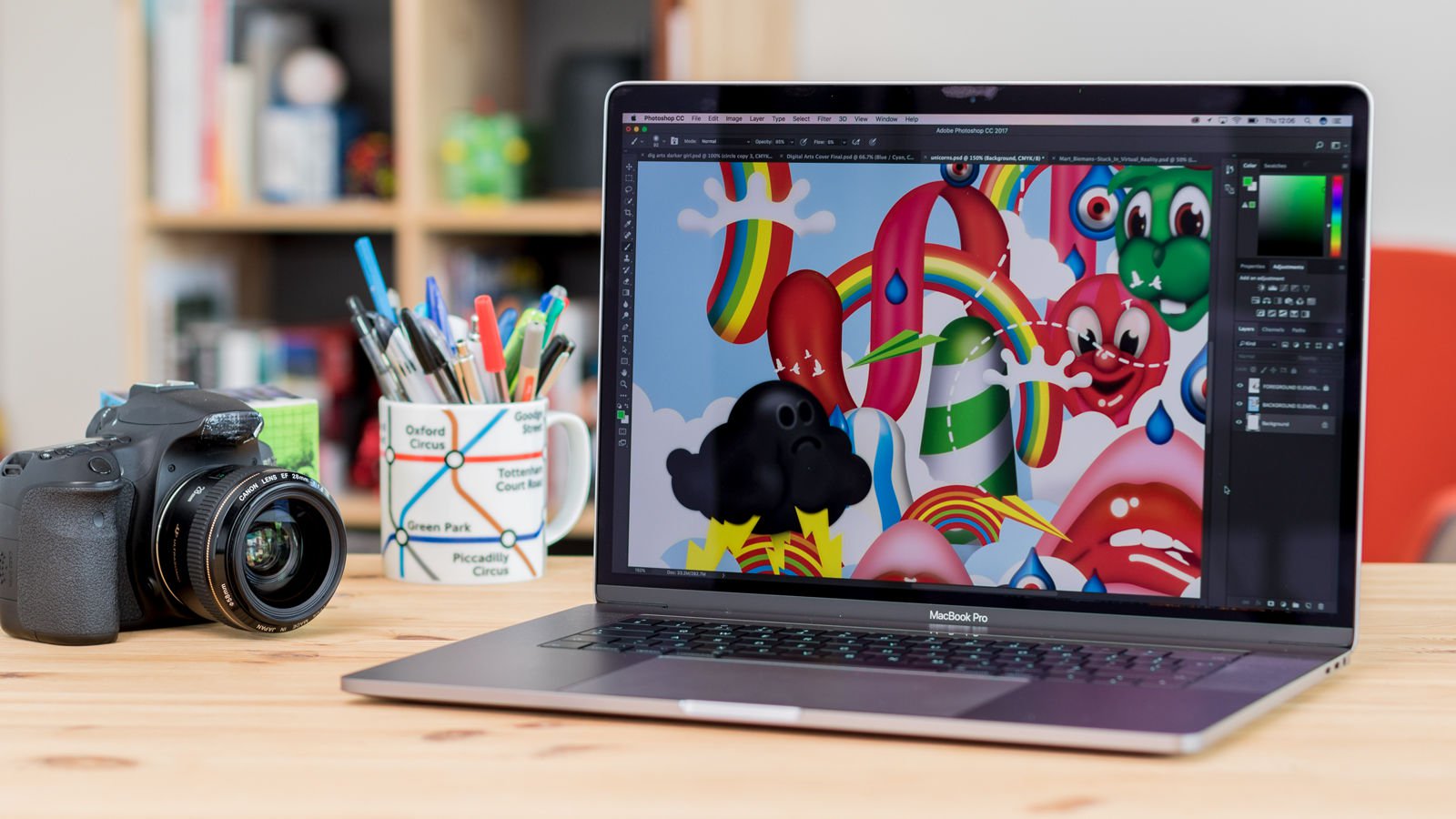
It’s always an event when Apple launches a MacBook, both literally and figuratively. This year though MacBook Pro fans will have to settle for an internal spec improvement rather than radical design overhaul.

As has been the case since Apple ditched the 17-inch MacBook Pro back in 2012, there are two sizes of MacBook Pro in the 13-inch and the 15-inch models. As we said in our preview of the 13-inch MacBook Pro, the 15-inch model is more deserving of the name "Pro" than it"s smaller sibling. However, is it truly a pro machine?

The Pro status of Apple’s 15-inch MacBook depends on what sort of ‘pro’ you are. Traditionally creative pros would have turned to the Mac for their needs, be it design work, editing photos, working with video and animation, or other jobs that require decent graphic capabilities.

Other MacBook Pro users might include gamers, programmers, and office workers who need a capable Mac with a larger screen than the 13-inches offered by the other Mac laptops.

We will be considering all these users as we evaluate the 2017 15-inch MacBook Pro. Is the new MacBook Pro going to answer their requirements or would they be better off with a different Mac, or dare we say, a PC or Linux machine.

The two changes to the MacBook Pro models launched at WWDC in June 2017 are the Kaby Lake processors and the improved graphics. Do those updates combine to make this a five star machine?

You can also read our comparison of all the "pro" Macs here, find out which is the best Mac for pros, and we also have a comparison of the two MacBook Pro models here.

Price and availability


The MacBook Pro remains an expensive computer:
  • 2.8GHz Kaby Lake i7 quad-core processor, Touch Bar, 16GB RAM, 256GB storage, Radeon Pro 555, £2,349/$2,399

  • 2.9GHz Kaby Lake i7 quad-core processor, Touch Bar, 16GB RAM, 512GB storage, Radeon Pro 560, £2,699/$2,799


Build-to-order options:
  • 3.1GHz Kaby Lake i7 quad-core processor + £190/$200

  • 1TB SSD + £360/$400

  • 2TB SSD + £1,080/$1,200


Apple also offers the older 2015 Broadwell chip 15-inch MacBook Pro priced at £1,899/$1,999. It is now the only MacBook that Apple sells, in any line and any screen size, that has ports such as USB-A, HDMI and an SD card slot.

Design and build quality


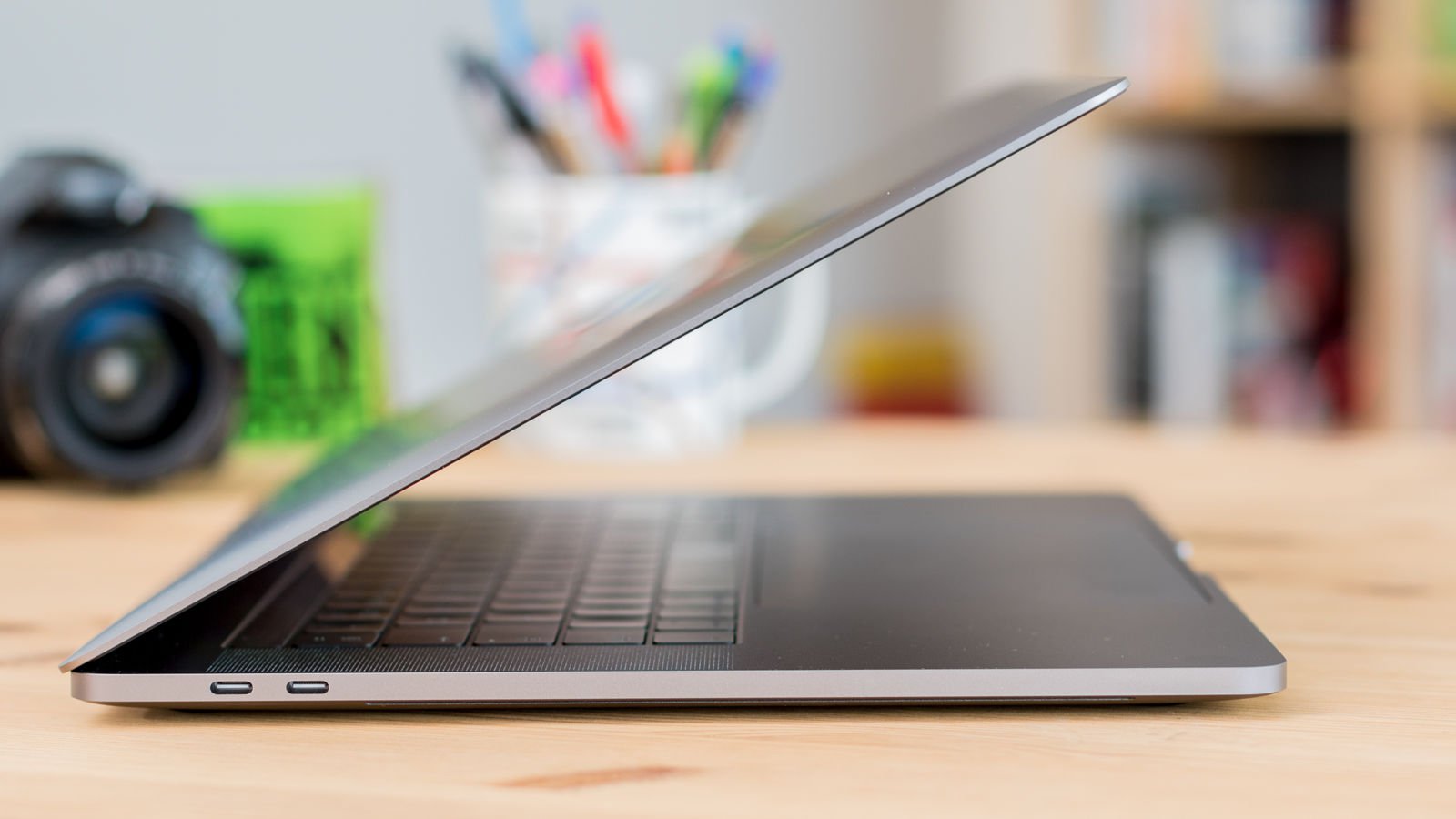
Reservations about the price aside, this is out and out a premium laptop. For a 15-inch device it is remarkably slim, keeping an identical profile to the 2016 model. Our review unit was Space Grey, our preferred colour, but you can go for the classic MacBook silver too.

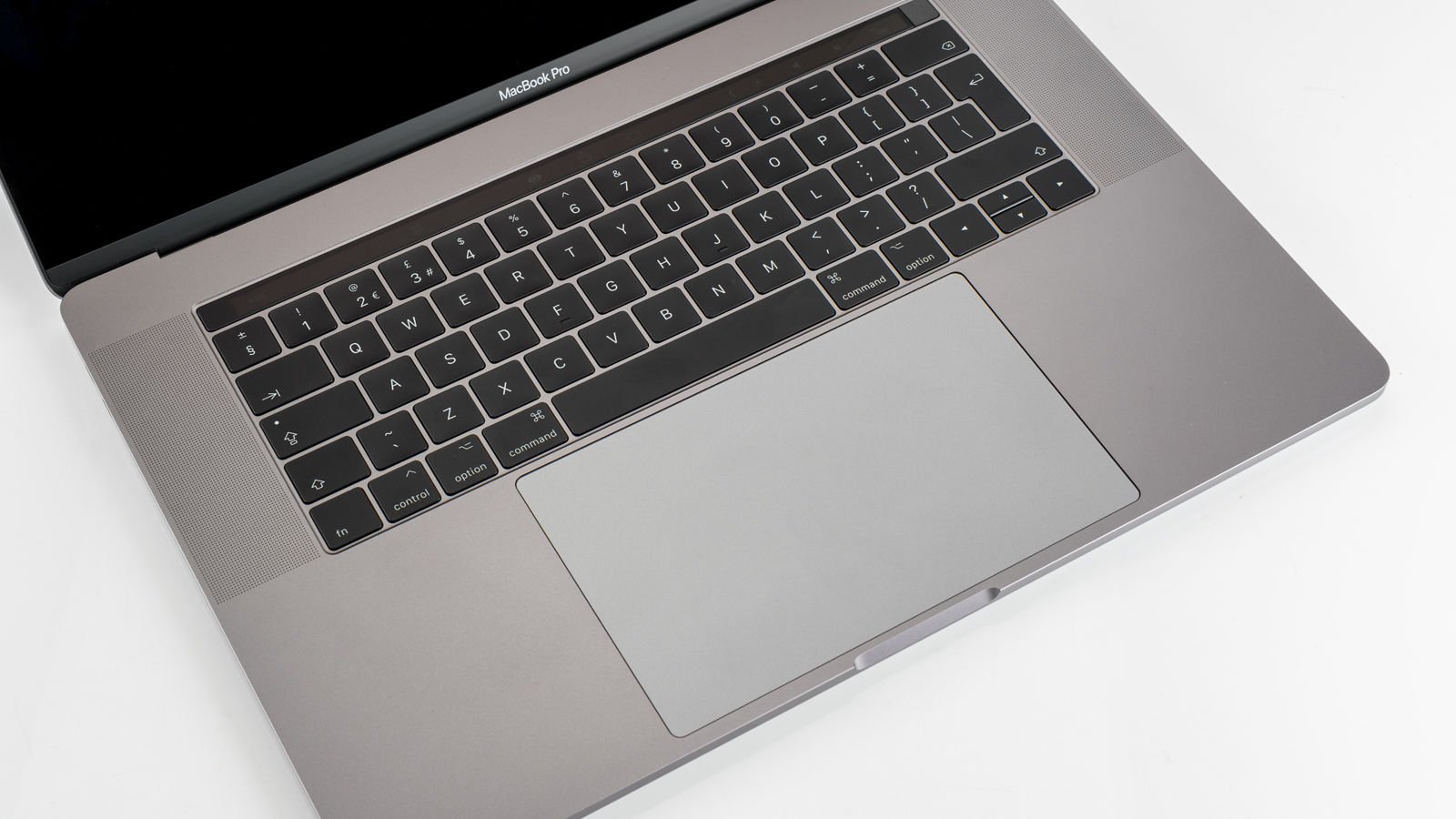
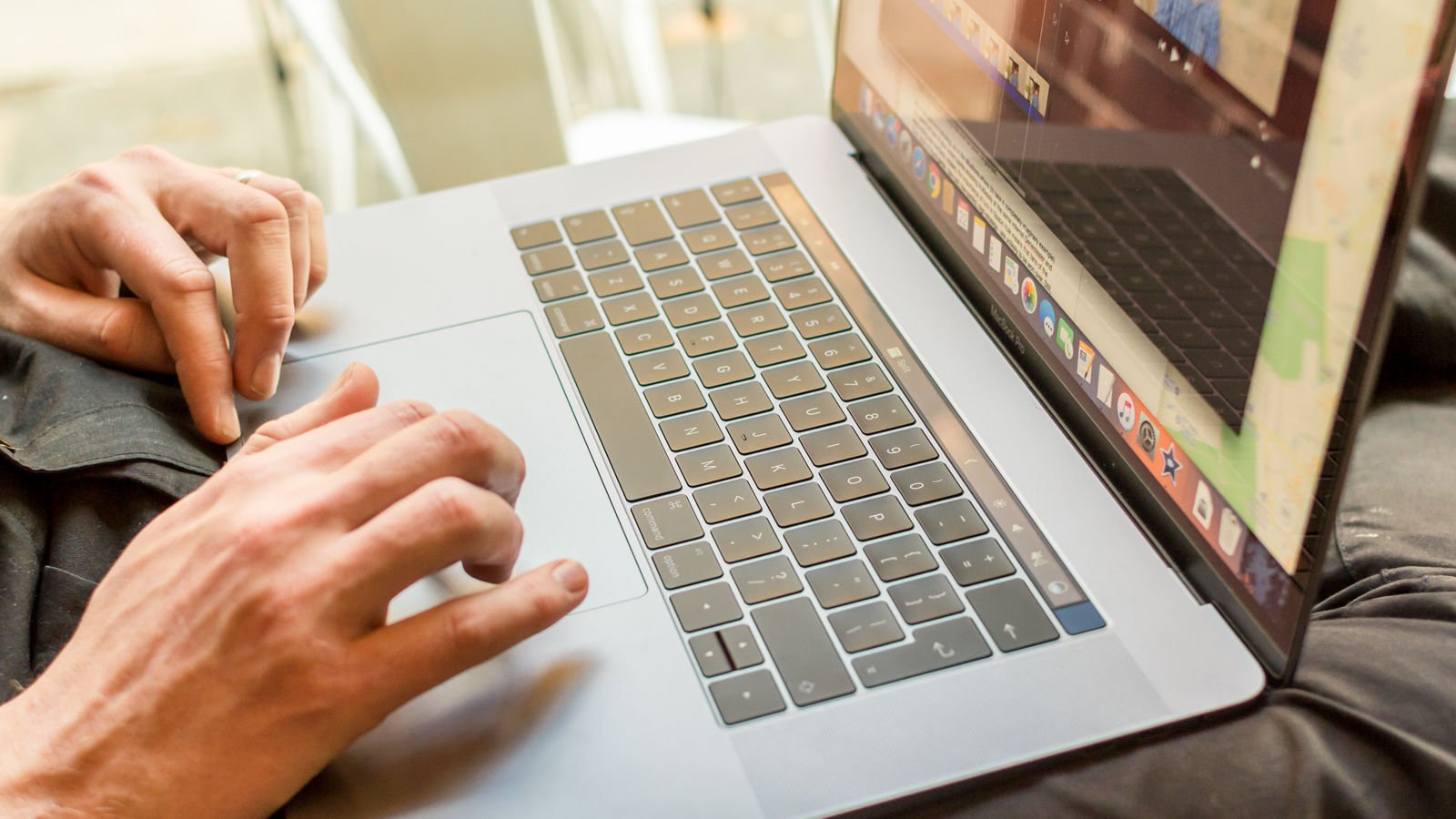
This means you are faced with a stunning Retina display with pleasingly thin bezels a full size keyboard with Apple’s improved second-generation butterfly keys and that now famous (infamous?) Touch Bar. We’ll get more into that further in.


There is also a convenient Touch ID fingerprint reader worked into the Touch Bar, while the 15-inch design allows for symmetrical speaker grilles either side of the keyboard. As usual, Apple excels in its positioning of the trackpad; here it is huge but we never found our palms encroaching on it.

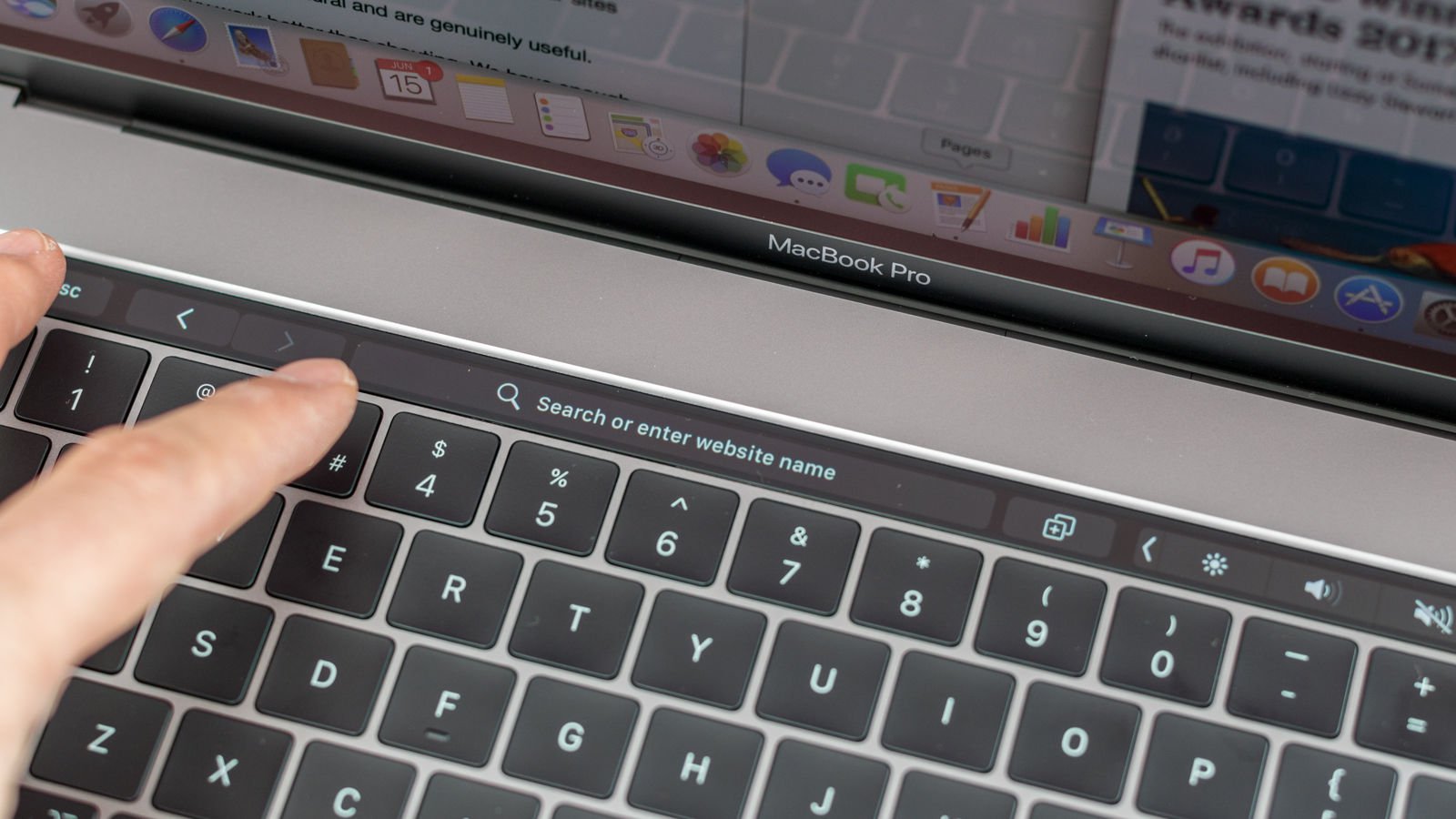
The Touch Bar itself remains, and it will again continue to divide opinion. From a purely design point of view, it’s great. It works well with no lag and the interface is surprisingly intuitive for such unique hardware.

At first it’s jarring, but over extended use you will start to enjoy its quirks – though if you use many programs that simply need function keys at all costs, it’s going to really annoy you.

The impressive slim form factor is largely possible thanks to Apple’s removal of some, debatably pro, ports. Long gone is the CD drive, but also carried over from last year’s model is the absence of any ports other than four USB-C (Thunderbolt 3, two on each side) and a solitary headphone jack.


Apple’s design here is commendable in how it is instantly recognisable as a MacBook. So far down the product line, it’s still exciting to open it up out the box and still be familiar with the lineage. If this turns out to be your first MacBook though, then you will be truly spoilt by the attention to detail, from the precise cut of the chassis to the minimalist cut keys.

Features and specs


The form factor for a 15-inch machine is impressive, with the Pro measuring 34.93 x 24.07 x 1.55cm when closed. Yes, 1.55cm thick on a MacBook Pro. 2017 eh, it’s the future!

It’s 1.83kg, a weight that is well distributed. You may not want to carry it in a messenger bag but it’s certainly in the ‘portable’ bracket more than ever before.

Display


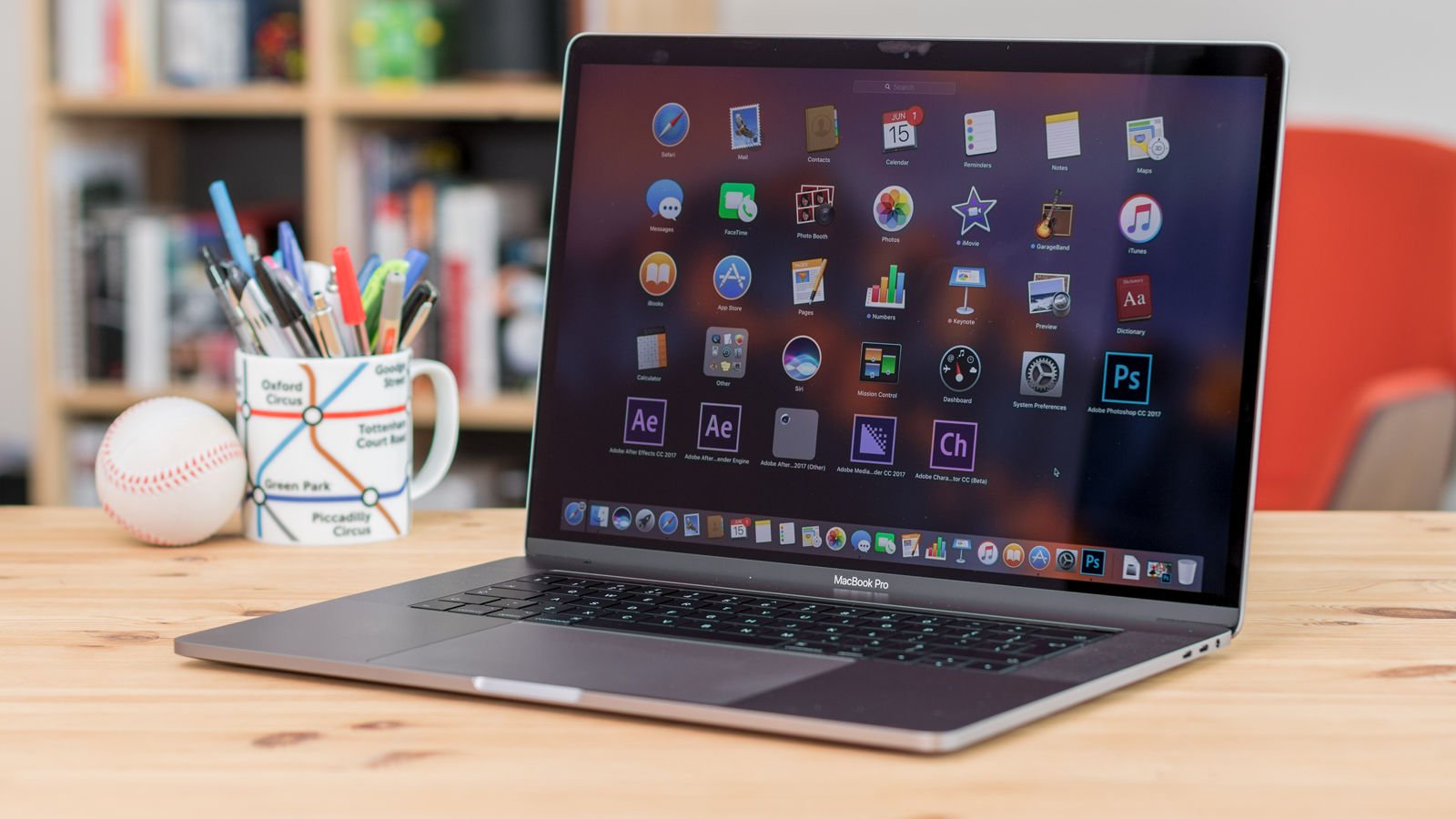
The laptop has a 15.4-inch backlit Retina display and yes, it looks amazing as we’ve come to expect from Apple. The 2880x1800 resolution is a dream no matter what you’re looking at, and is, for all day use, preferable to the 13-inch alternative.

It boasts 220 pixels per inch with an often blinding 500 nits brightness and a P3 wide colour gamut. Viewing angles are outstanding and there is zero light bleed from any corner or edge.


It supports several scaled resolutions up to 1920x1200, but the absence of HDMI means you’ll need the requisite adapter.

It’s worth noting that many Windows rivals now have 4K displays, something that Apple has never offered on a MacBook. Considering the high price of the 15-inch MacBook Pro, if you need a 4K display then the 21.5-inch iMac starts at £1,249.

Trackpad and keyboard


Yet with just 15 inches, multi-window use is exemplary, particularly in conjunction with the excellent trackpad, which measures a massive 159x99mm. Apple remains a class-leader in input with Force Touch, the pressure sensitive technology that allows for simulated clicks and actions using only haptic feedback under the pad.

You can, for example, press harder for a deeper click and take advantage of another function depending on the app or program you are in. It becomes second nature after a while. It’s also preferable to a mechanical trackpad because you can click anywhere on it, even at the top.

Multi-touch gestures take a while to learn and they are limited in the main OS but become useful for editing purposes in pro apps like Final Cut. Being able to apply two kinds of pressure to a trackpad has opened up a wealth of existing and future possibilities for developers too, and is a clear and well-executed advantage over PC counterparts.


Typing on the MacBook Pro is practially a desktop experience such is the quality of the set up. The 65 keys on the UK version (64 on US models) use Apple’s second generation of butterfly keys that respond excellently no matter where pressed.

They have shallower travel than all MacBook Pro models 2015 and earlier though, so you may want to test them out before taking the purchase plunge. If you’re used to that kind of travel, you’re probably still going to be frustrated at the adjustment required.

Each key is backlit with its own LED, which is pretty luxurious. The combination of expansive, responsive trackpad and high quality keyboard in a 15-inch laptop that remains extremely portable is very attractive, but be aware of the changes.

In a minor change from 2016, the control and option keys now denote keyboard shortcuts as opposed to the previous markings that helped PC users translate Mac functions.

Processor, RAM and graphics


The update for 2017 is internal. There are finally Kaby Lake processors, Intel’s seventh generation chips. They offer higher boosted clock speeds than their predecessors, and means Apple has caught up with the HP ProBook 400 range, Dell XPS 13 Touch, Acer Aspire E, and Asus ZenBook 3 that all have Kaby Lake chips.

Our review unit is the high-end 2.9GHz quad-core Intel Core i7, which can turbo boost up to 3.9GHz and has 512GB storage with 16GB of 2133MHz LPDDR3 onboard memory. This RAM tops out in the range at 16GB, but works at a higher frequency than last year’s 1,866MHz.

There are calls for Apple to offer up to 32GB RAM in the MacBook Pro, with fingers pointing to Dell’s Precision 5520 laptop, which has a 32GB RAM build-to-order configuration.

Back in November 2016 Apple"s SVP of Worldwide Marketing Phil Schiller spoke out after criticism that the MacBook Pro topped out at 16GB RAM, saying that if Apple was to offer more RAM it would be detrimental to battery life. This is because the higher amounts of RAM would require a power-hungry memory controller.


Schiller said: "To support 32GB of memory would require using DDR memory that is not low power and also require a different design of the logic board which might reduce space for batteries. Both factors would reduce battery life.”

Unfortunately even the Kaby Lake processor upgrade for the MacBook Pro could not increase the RAM cap of 16GB because the Kaby Lake processor doesn"t support LPDDR4 RAM either.

That said, 16GB RAM is a lot and will perform admirably for all but the most demanding of users. Add to it a Radeon Pro 560 GPU with 4GB of GDDR5 memory paired with Intel HD Graphics 630 and you’re fully loaded. The advantage here is a separate dedicated graphics card – on the 13-inch MacBook Pro it’s lower spec and integrated.

Bear in mind that with this much power under its hood, the MacBook Pro needs a fan, unlike the fanless 12-inch MacBook.

The stereo speakers on the MacBook Pro also delight, with a decent dynamic range and often surprisingly good bass response. The 15-inch display is great for solo movie viewing as much as it is spreadsheet crunching or video editing.

The Pro is moving the goalposts every year; it’s no longer just for professional users, which is to the annoyance of some. But the versatility of an admittedly expensive machine is preferable, particularly if you’re forking out for one to use as your main device. Just because you’re a videographer, doesn’t mean you don’t want to sit in bed and binge Netflix. You can do both with the 15-inch MacBook Pro.

The review continues on the next page.

Benchmark results and analysis


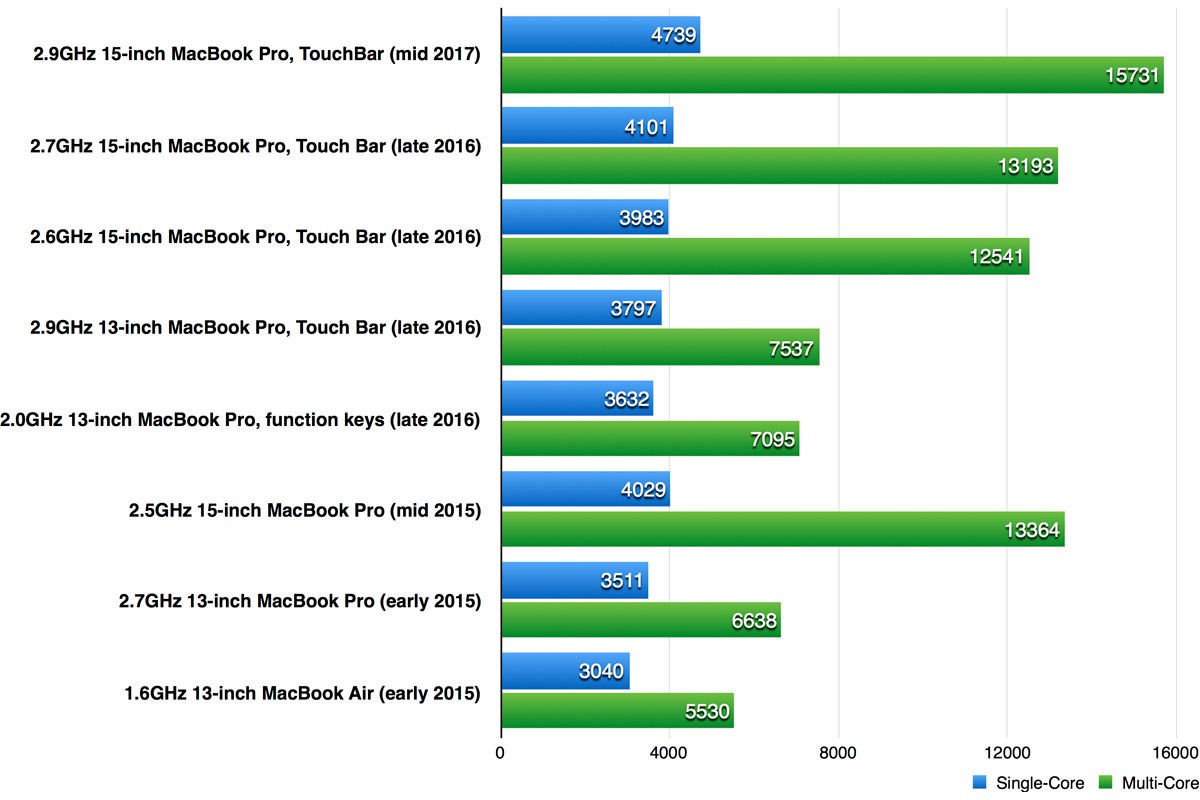
The following results show how this new model compares with the previous year’s top of the line model, the 2.7GHz 15-inch. We also have the 2.6GHz 15-inch from 2016, and the 2.9GHz 13-inch and 2.0GHz 13-inch models for comparison.

Geekbench 4.1 64-bit Single-Core and Multi-Core Score


That"s a notable difference (especially when you notice that the 2016 model actually seems to perform worse than the 2015 2.5GHz MacBook Pro which scored 13,364 in the multi-core tests).

In terms of processor there are two big difference between the 13-inch and 15-inch models. The 15-inch models have i7 quad-core processors, while the 13-inch models only i5 dual-core processors.

You might be looking at processor speed and thinking that some of the 13-inch models look better than the 15-inch MacBook Pro, but this is where the difference between quad-core and dual-core comes in.

Because the 15-inch model has four cores the speeds might not look as impressive as the 13-inch MacBook Pro, but remember there are four processors rather than two and that makes a huge difference.

The other major boost comes with the i7 versus i5 processor. We noticed this quite prominantly when we compared the MacBook Pro to the 27-inch iMac, which also features a quad-core processor, but in this case the processor is an i5 variety. (The new iMac is reviewed here: iMac 27-inch (2017) review)

When we ran Geekbench on the 2017 27in 3.4GHz iMac we got a single core score of 4,833 and a multi core score of 15,731, while the MacBook Pro managed 4,739 in single core mode and 15,731 in multi core. That faster multi core result from the MacBook Pro is partly thanks to the i7 chip.

Graphics


With the 2017 MacBook Pro Apple has essentially bought the graphic processors into line with its rivals. The 15in models now offer the Radeon Pro 555 or 560 (replacing the Radeon Pro 455).

That’s not the only graphics related news though. There are some encouraging changes coming in Apple’s upcoming version of macOS.

High Sierra has a focus on graphics, perhaps as a result of Apple’s eagerness to get onboard the VR bandwagon. Of particular interest to anyone working in the creative industries will be the fact that the new OS will support external graphics.

We have some benchmarks here for the 2017 15-inch 2.9GHz MacBook Pro.


Geekbench 4.1 Open CL Intel Integrated Graphics Score


20,976


Geekbench 4.1 Metal Intel Integrated Graphics Score


19,225


Geekbench 4.1 OpenCL Discrete Graphics Score (Radeon)


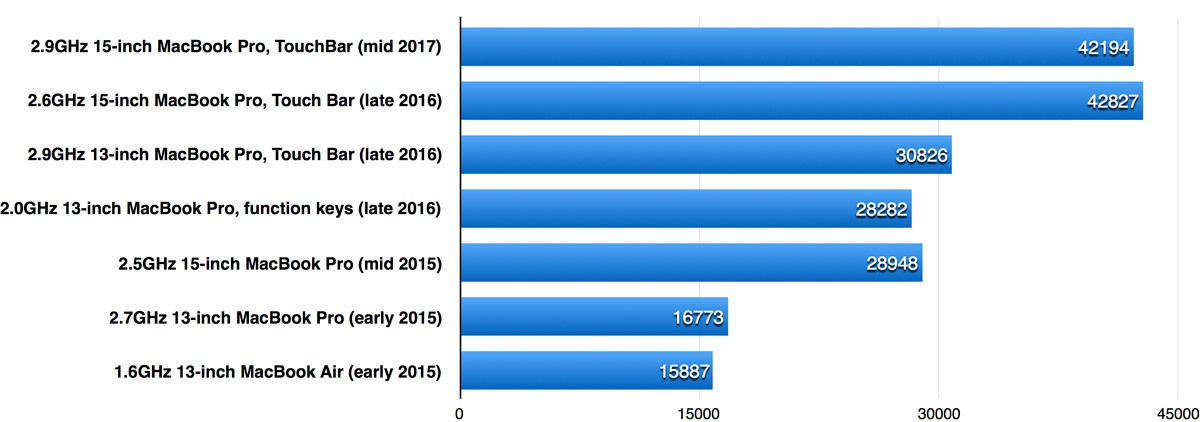
42,194


Geekbench 4.1 Metal Discrete Graphics Score (Radeon)


26,416


Cinebench OpenGL(fps)


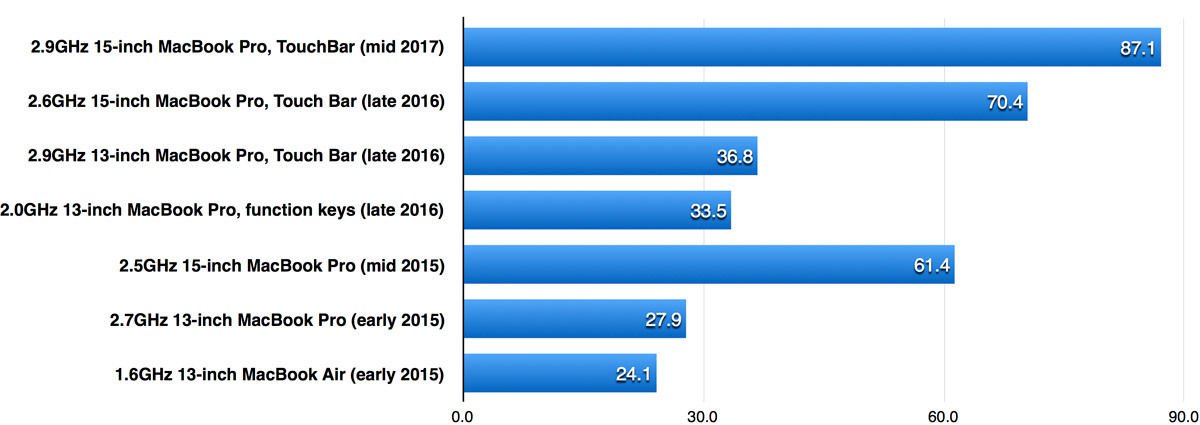
87.08


BlackMagic Write (MBps)


1,951.14


BlackMagic Read (MBps)


2,397.08


Looking specifically at the OpenCL (Radeon) test and the Open CL Cinebench tests gives us some insight into the improvements in terms of the graphics card in comparison to previous models of the MacBook Pro:

Geekbench 4 OpenCL (Radeon)


We also ran a pair of graphics benchmarks to test the speed of the discrete graphics card. In the Geekbench 4 OpenCL test, the 4GB Radeon Pro 560 in the new 2.9GHz MacBook Pro saw a similar score to the 2GB Radeon Pro 450 in the 2016 2.6GHz 15-inch MacBook Pro.

Cinebench OpenGL (fps)


In terms of frames per second, the 2.9GHz MacBook Pro score was 14 per cent better at 87.1 frames per second, that of the 2016 2.6GHz 15-inch MacBook Pro. These are impressive results.

In addition, the Unigine Valley Benchmark 1.0 software gave a result of 18.9fps when in Extreme HD setting, the highest possible rendering rate, and scored overall 789.

Similarly, we ran the AJA System Test benchmark at maximum performance and largest resolution setting (5K RED), which is a 4GB test file. Results showed the MacBook Pro with a write speed of 2054MB/s and read speed of 2574MB/s.

Touch Bar


Despite it growing on us as we use it, it still remains disappointing that Apple has focused on the Touch Bar to differentiate this model of Pro for the second year running.

It is becoming clear that Apple doesn’t intend the MacBook Pro to ever become a touchscreen device and that the Touch Bar is the compromise – and herein lies the problem. On a machine that has only USB-C ports, compromise may have gone a little too far for some users now that they no longer have a normal function key row.


The Touch Bar isn’t completely pointless though. Along with Touch ID capabilities, there is integration with a number of Apple apps, such as Safari, which gains forward and backwards buttons, or Mail that gains auto complete suggestions.

What really matters to pro users though are apps like Photoshop, and Adobe is working on integrating Touch Bar controls into it. You can already use the MacBook Pro Touch Bar in Photoshop, but the features are currently only in Preview (e.g. beta). Hopefully macOS High Sierra  will bring added functionality. Read about what you can do with the Touch Bar here.

There’s not a non-Touch Bar version of the 2017 15-inch Pro. We wouldn’t be surprised if Apple introduces one though, as users might prefer it not only for familiarity but for the massive cost saving.

Ports (or lack thereof)


One other thing that could be beneficial to pro users is USB-C with Thunderbolt 3. There are four here, and there’s no denying the improved versatility of a port that can cope with charging, data transfer at great speeds and external monitor output. But if all your peripherals are USB-A or you use HDMI and an Ethernet cable, you’re going to be swimming in dongles. Expensive dongles.

Apple’s solution to this problem is still selling the old 2015 15-inch MacBook Pro, which offers the USB-A slot.

That model is also the only choice for business users who would prefer a 15-inch model but don’t require such high-specs, or want to pay the high price for the new 15-inch MacBook Pro.

This is basically the issue we have with the MacBook Pro: if you want a 15-inch screen you will be spending a lot of money on specs you don’t really need. Or you will be buying a model that’s two years old for at least £450 less.

Software


The machine runs macOS Sierra 10.12.5 out the box, and it is a nicely refined version of Apple’s longstanding Mac operating system. If you’re used to El Capitan then not much has changed but you do get Siri, if you don’t mind talking to a computer.

It integrates well, much like Apple Pay and the Touch ID reader. Quickly paying for items on supported browser websites is a nerdy delight, even though we’ve all done it on our phones by now in apps. Unlocking the computer with biometrics for the first time on a MacBook adds a welcome layer of security.

Buying advice


If you bought a new MacBook Pro last October you might be a tiny bit miffed. After all, your machine has just been surpassed within months. Does it really matter though? Probably not because chances are you aren’t a creative professional who needs the best processor and graphics card as well as a ton of RAM. And if you are, we’ll maybe you are holding out for the hoped for MacBook Pro with 32GB RAM.

The MacBook Pro is for a demanding user who needs a decent amount of power. If all you do with your Mac is surf the web and open emails then probably a MacBook or MacBook Air will suffice (although the MacBook Air hasn’t had a significant update in a while).

If it’s the 15-inch screen that’s attracting you perhaps a 13-inch MacBook Pro, or other Mac laptop paired with a bigger display would do the job just as well.

Perhaps it’s portability you need. The MacBook Pro isn’t the lightest laptop Apple makes (that’ll be the MacBook) but it is a lot lighter than it was back in 2015. And if you were thinking of buying the older 2015 model that’s still on sale - that’s the £1,899/$1,999 15-inch model with a 2.2GHz Broadwell processor, bear in mind that it’s quite a bit heavier.

With all that in mind though, if you want a bigger screen and would benefit from a discrete graphics card, rather than one of the integrated ones (which wouldn’t be as good for things like games and creative work), then the 15-inch MacBook Pro is a great choice. We just wish it wasn’t so expensive!