Samsung is rumored to launch the Galaxy S9 earlier than expected next year so that it can better face the iPhone X threat. Reports also say the new Samsung handset will feature some iPhone X “tricks,” although it’s not clear what that means.
Yes, the Galaxy S9 will undoubtedly feature a dual-lens camera like the Galaxy Note 8, but that’s not the iPhone X’s signature feature. What else can the Galaxy S9 steal from the iPhone X? Face ID is one likely candidate, assuming Samsung can develop similar facial recognition technology in time for the Galaxy S9’s launch. The design may be one other iPhone X feature the Galaxy S9 will borrow. And then, there’s the now-famous iPhone X notch.
Galaxy S8 users are right to point out that Samsung beat Apple when it comes to releasing an “all-screen” smartphone. That’s true, the Galaxy S8 came out before the iPhone X, but each company has its own interpretation of all-screen designs.
The Galaxy S8 features symmetrical top and bottom bezels, while the screen sides are curved. The iPhone X’s screen occupies the entire front of the handset save for the top notch and the small bezel that surrounds it. In my opinion, Samsung should just stick with its own Infinity display design for at least one more year. But maybe Samsung wants to eliminate the bottom bezel as these fan-made concepts suggest:
https://twitter.com/UniverseIce/status/930662768642068482
Here’s one other version:
https://twitter.com/UniverseIce/status/930287942475509760
These aren’t official renders of the Galaxy S9’s design, so don’t get too excited — or disappointed. But they suggest that at least some Samsung fans out there are toying with the idea of Samsung extending the display even further.
There’s no notch at the top in these designs, which is a good thing. That’s probably a design compromise Samsung should stay away from.
Wednesday, 15 November 2017
Galaxy S9 might look like if Samsung copies the iPhone X

Thursday, 14 September 2017
Apple’s Face ID will support only one registered face per iPhone at launch
Apple’s forthcoming Face ID technology will support just one face registered per device, at least initially. This has been reported by multiple people who spoke to Apple at this week’s iPhone event, and confirmed separately, but it’s worth noting because it could change some user behavior regarding the device.
Also Read: Face ID is replacing Touch ID on iPhone X
Face ID supporting just one face makes a lot of sense on the face of things (sorry), since unlike with Touch ID, users have only one face to use for their unlocking purposes. Touch ID ostensibly allows multiple fingers to be registered because you have quite a few digits of your own, and depending on how you’re using the device or in which pocket you keep it, one might be more convenient to use than another.
The issue is that people also often register the fingerprints of their significant others, or even kids, depending on how they use their device. The phone can store up to five fingerprints, which makes it relatively easy to keep a few of your own as well as those of a significant other on your device just in case.
A one phone, one face policy obviously won’t support that kind of arrangement: If you want to give your loved one access, you’ll need to smile for the camera, or share a backup passcode so they can get in that way. The passcode option is only marginally more inconvenient than a registered Touch ID fingerprint, of course, but it still makes a difference, especially if someone’s only very occasionally accessing your device and might not have committed a pin to muscle memory as a result.
Also Read: Top 3 features of Apple iPhone X
I think this is more of an issue if Apple ends up moving Face ID across its product line, to devices like iPads that are much more often shared gadgets. Still, depending on how your use your phone, it might be another decided factor in whether you go with iPhone 8 or iPhone X – or, of course, neither.
Wednesday, 13 September 2017
Face ID is replacing Touch ID on the new iPhone X
So to keep your phone secure Apple is introducing Face ID, which lets you unlock your phone by just looking at it. This new scanning feature also replaces Touch ID for Apple Pay and other apps that used Touch ID to authenticate users, like banking apps.
Apple just introduced the new iPhone X, and the full edge-to-edge screen means no more home button. No more home button means no more Touch ID, since that’s where Apple put the fingerprint scanner in older phones.
Here’s how it works: The new iPhone X takes a 3D scan of your face from all angles the first time you use the phone. It then saves that scan of your face inside the iPhone X’s secure enclave hardware chip, and compares it when you want to unlock your phone.
Apple uses a bevy of new hardware to capture this 3D facial map – including a dot projector, traditional front-facing camera, flood illuminator and infrared camera. It’s essentially an Xbox Kinect miniaturized and put on the front of your phone.
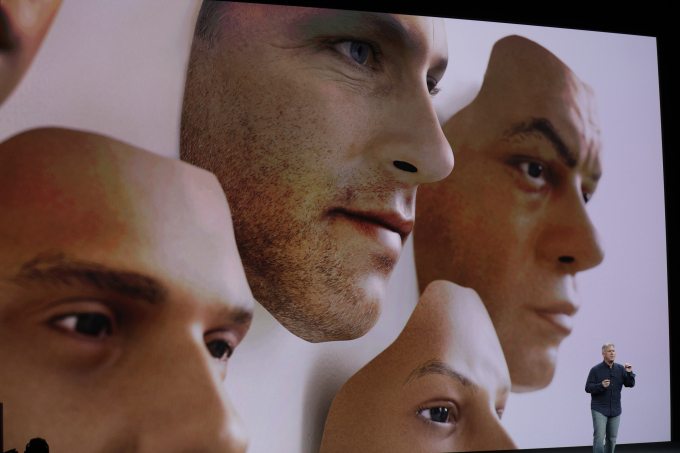
Apple says the facial scan is so accurate there’s now only a 1 in 1,000,000 chance of another random person’s face being able to unlock your phone. This is much better than the 1 in 50,000 error rate for Touch ID. And no, holding a photo up of someone can’t unlock their phone – nor can a Hollywood-grade face mask, which (shown below) were used by Apple’s engineering teams to train the feature.
Source: TechCrunch
Top 3 features of Apple iPhone X
After years of being called out for lack of innovation, Apple announced an ultra high-end iPhone--in addition to its annual incremental hardware upgrades. As expected, Apple unveiled its 10th anniversary iPhone on Tuesday. After years of incremental—sometimes underwhelming—updates to the iPhone, the new iPhone X sports a series of bleeding edge innovations in what Apple called "The future of the smartphone."
From its laptop-level performance with a 6-core processor to a nearly edge-to-edge OLED screen to Face ID login to an AR-enabled infrared camera, the iPhone X leaps forward in ways that its competitors are destined to emulate.
However, these innovations resulted in a couple design compromises—the iPhone X loses the classic home button and Touch ID fingerprint scanner.
The iPhone X has glass on the front and back—which will make it less slippery than the metal backs on the last few iPhones. It comes in two colors, space gray and silver. It starts at $999 with pre-orders opening on October 27, and the iPhone X arriving in stores on November 3. That compares to the iPhone 8, which starts at $699 and arrives September 22.
Let"s break down the top three features that professionals will care about in the iPhone X (pronounced "iPhone Ten").
1. Super Retina Display
The signature feature of the iPhone X is the nearly bezel-less 5.8-inch OLED screen with 2436x1125 resolution. It"s an upgrade from the 5.5-inch 1080x1920 LCD on last year"s iPhone 7 Plus. The killer feature is that the bigger screen comes in a smaller package since it eliminates the bezel—so the iPhone X is roughly the same size as the iPhone 8 (with its 4.7-inch screen) while offering a larger screen than the iPhone 8 Plus.
Apple has dubbed this the "Super Retina Display" and it features 458 ppi, HDR10, and Dolby Vision technologies.
2. Face ID
Apple replaces Touch ID with Face ID, its biometric facial recognition scanner. The iPhone X makes a 3D mathematical model of your face using its "True-Depth Camera System," which includes a new infrared camera. It maps 50 facial muscles in real-time and uses machine learning to recognize you even if you cut your hair, put on your glasses, wear a hat, or are in a dark room.
All the processing is done on the A11 processor on the iPhone X and is not sent to the cloud, according to Apple"s Phil Schiller. He said that the ability for someone to unlock Touch ID with a similar fingerprint is 1 in 50,000, while the odds jump to 1 in a million for Face ID. Schiller also said that Apple worked to make sure it couldn"t be spoofed by photographs and even brought in Hollywood makeup artists to help make sure it couldn"t be faked by prosthetic masks.
To activate Face ID, a user raises the phone to wake it up, swipes up from the bottom of the screen, and looks straight at the phone. It will work with Apple Pay as well.
I still wonder if Face ID will be as fast and convenient as Touch ID, which you don"t have to be looking at your phone to use. I also have my doubts about whether Face ID will work when you"re wearing sunglasses or have odd shadows or lighting on your face.
3. Augmented reality
With ARKit, Apple leapt into the augmented reality space with a solution to empower developers in turning the iPhone into an AR platform. And while the success of Pokémon GO showed that even older iPhone hardware could be used for AR, the iPhone 8 and iPhone X hardware open up new possibilities for AR with more powerful cameras.
The iPhone X"s "True-Depth Camera System" was built not just for Face ID but also AR. The infrared camera and mapping capabilities will give developers a lot more power and detail to work with in creating AR experiences. We"ve barely scratched the surface of what"s possible, but it"s going to be very interesting to watch what developers will do by pairing ARKit with the AR hardware in the iPhone X—especially enterprise developers.
Source: TechRepublic