Showing posts with label Nikon. Show all posts

Friday, 29 December 2017

The best telephoto lenses for Canon and Nikon DSLRs in 2017

Telephoto lenses are great at making distant objects fill your frame, but they can be equally useful for capturing closer subjects. With long focal lengths comes a shorter depth of field and creamier background bokeh blur, which is just the ticket for isolating a nearby object of interest.

Telephoto zooms can be picked up at relatively low prices and often have a decent zoom range like 70-300mm. However, you"ll need to up your budget to get something with a wide aperture that stays constant throughout the lens"s focal range – this gives you much more flexibility when you"re shooting in low light and generally means better image quality too.

Fast, near-silent autofocus systems are worth paying for because they make the lens smoother to use, while fancy glass elements reduce aberrations like distortion and color fringing, and weather sealing protects your lens in bad weather. Optical image stabilisation is practically a must-have when using telephoto lenses, and you do without it at your peril.

The maximum focal length of the lenses in this roundup is 300mm, and this is fine for most sports and some wildlife photography. If you need more magnification than this, though, you"re into super-telephoto photography, which you"ll find in a separate guide.

APS-C versus full frame


DSLR sensors come in two sizes. Most use APS-C size sensors roughly half the size of the full frame cameras by professionals, and this has an impact on the effective focal length and magnification of the lens.

So if you"ve got a 70-300mm telephoto, that effectively becomes a 105-450mm lens on an APS-C format DSLR. That"s rule number 1.

Rule number 2 is that some lenses are designed solely for APS-C cameras. You can"t use them on a full-frame model (well you can with Nikon DSLRs, but only in an APS-C "crop" mode which defeats the object).

With some lens types, like wide-angle zooms, you have to get a lens made for your camera"s sensor size, but with telephotos it"s a lot simpler. Almost all of those we recommend are designed for full frame cameras so they"ll work on APS-C models too. This is ideal because it means you can keep your lens if you upgrade to a bigger camera later. There are a couple of lenses designed only for APS-C cameras - these are marked EF-S on Canon lenses, DX on Nikon, DC on Sigma and Di II on Tamron.

Friday, 24 November 2017

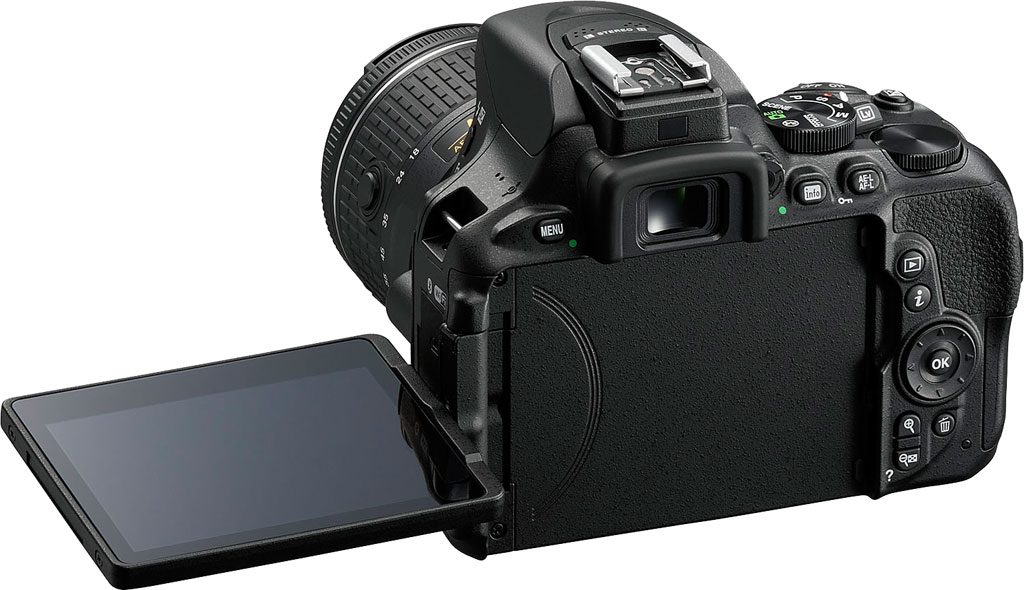
Nikon D5600 review

Nikon recently released a new camera in their D5xxx range with the Nikon D5600. Rather than a complete overhaul, the company has opted for a modest upgrade. Here we take a look at the Nikon D5600.

Features in the Nikon D5600


Most of the features of the device are quite similar to the previous iteration. The resolution is stuck at 24.2 MP and has the APS-C-sized CMOS sensor. Furthermore, the cameras share the EXPEED 4 image processor and have the same ISO range. There is the same 3.2-inch vari-angle touchscreen display with a 1,037,000-dot resolution, although its operation has been improved. It now offers the frame-advance bar we have seen on both the D5 and D500 to speed up toggling through images, as well as a crop function for use during playback. The time-lapse movie function makes its way to the camera too and is an addition not found in the previous model.

Build and autofocus of the Nikon D5600


The design of the D5600 is no different from the shell of the D5300 and D5500. It uses a monocoque build and is made of polycarbonate. The buttons are in the same location as the D5300 and it comes with a 39-point Multi-CAM 4800DX AF system. Autofocus happens pretty fast and is quite accurate.

Performance of the Nikon D5600


The Nikon D5600 can do burst shots of up to five frames per second which is the same for the D5500. The Matrix metering system works quite well and adapts itself to a wide number of situations. An area the camera excels at is its battery life. It can take approximately 820 shots on a single charge. It does not have 4K video but it can shoot 1080p at 60p, 50p, 30p, 25p and 24p frame rates. There is a small stereo microphone positioned just in front of the hotshoe.

Tuesday, 14 November 2017

Nikon D3400 Quick Review

The Nikon D3400 is the company’s latest device aimed at the entry level market. Read on as we take a look at what has changed and what is new.

Design and build of the Nikon D3400


The design is very similar to the previous D3300. A Polycarbonate construction is used for the camera. It weighs only 445g (without the battery) making it quite light and offers plenty of grip so you won"t have to worry about dropping it. There is soft rubber around the grip that helps improve the feel. The buttons are easy to grip and use.


The Nikon D3400 has a 11-point Multi CAM 1000 AF system that comes with 3 D tracking. The autofocus is extremely quiet and works fast in good lighting conditions. Of course, the speed drops when it comes to low light scenarios. The built in guide mode makes the controls easy to figure out for a beginner.

Performance of the Nikon D3400


The camera has SnapBridge connectivity for image transfer and a battery that can last 1200 shots. The Auto White Balance works well, with just a few errors. It works better than expected under artificial lighting. It can do burst photography at 5fps. While its not excellent, it is good enough for most situations. The viewfinder delivers clear images while the LCD display is not touch screen and is fixed in place. There is no 4K video but the Full HD gives good shots. The sensor is a 24.2 MP sensor that is capable of delivering excellent levels of detail.

Nikon"s Picture Control options provide a sensible array of colour options, such as Standard, Vivid and Flat. Flat is a mode found in the more expensive Nikon cameras and it is nice to see the feature in the entry level D3400.

The Nikon D3400 sells at $499.95.